Functional Foremanship: A Comprehensive Overview
Functional Foremanship is a concept introduced by F.W. Taylor under Scientific Management. It focuses on improving efficiency and productivity in a factory system by dividing managerial and supervisory roles into specialized functions. Taylor believed that the concern for efficiency should begin right from employee selection, where each person is scientifically chosen and assigned tasks that match their physical, mental, and intellectual capabilities.
Definition of Functional Foremanship
In a factory system, the foreman represents a managerial figure who directly interacts with workers on a daily basis. The foreman is considered the lowest-ranking manager but also the highest-ranking worker, serving as the central figure around whom the entire production process revolves. Functional Foremanship extends this role by dividing it into specialized areas to ensure better planning, implementation, and control of tasks.
Purpose and Need
Taylor observed that a single foreman or supervisor often could not handle all the responsibilities effectively. Managing tasks such as planning, assigning jobs, supervising production, maintaining discipline, and ensuring quality required different skill sets that one person could not possess alone. To solve this problem, Taylor introduced Functional Foremanship, dividing the foreman’s duties among eight specialized experts, each responsible for a specific area of production.
Structure of Functional Foremanship
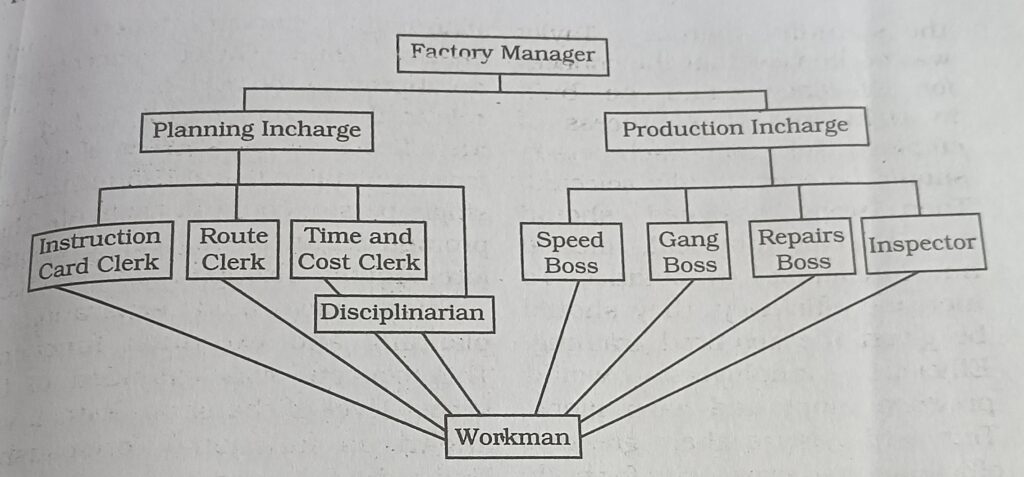
Under this system, the shop floor is managed at the lowest level of the organization, with responsibilities divided into planning and production functions. A factory manager oversees two main incharges:
- Planning Incharge
- Production Incharge
1. Planning Incharge
Responsible for preparing work instructions, setting routes, estimating costs, and ensuring discipline. The planning incharge has four key clerks:
- Instruction Card Clerk: Prepares detailed instructions for workers.
- Route Clerk: Determines the route of production for efficiency.
- Time and Cost Clerk: Estimates the time required and costs involved for each task.
- Disciplinarian: Ensures rules and discipline are maintained.
2. Production Incharge
Focused on timely and accurate execution of tasks. The production incharge is supported by:
- Speed Boss: Ensures workers maintain the required speed and productivity.
- Gang Boss: Organizes workers and provides them with necessary tools.
- Repair Boss: Maintains machines and tools, ensuring smooth operations.
- Inspector: Checks the quality of work and ensures standards are met.
Qualities of Foremen in Functional Foremanship
Foremen and specialists in this system should possess certain qualities, including:
- Intelligence and education
- Tact and judgment
- Technical knowledge
- Manual dexterity and grit
- Honesty, energy, and good health
Since these qualities cannot be found in one person, Taylor recommended dividing responsibilities among specialized foremen. Each specialist is assigned tasks based on their strengths—for instance, individuals with technical mastery and intelligence handle planning, while those with energy and physical strength manage execution.
Advantages of Functional Foremanship
- Increased Efficiency: Division of labor ensures tasks are handled by experts, leading to better performance.
- Better Supervision: With eight specialized foremen, each aspect of production is closely monitored.
- Improved Quality: The inspector ensures work meets the required standards.
- Reduced Burden: No single foreman is overloaded with multiple tasks.
- Specialization: Encourages workers and supervisors to develop expertise in specific areas.
Conclusion
Functional Foremanship is an essential principle of Scientific Management aimed at increasing efficiency and productivity in factories. By dividing the role of a single foreman into eight specialized functions, it ensures proper planning, smooth execution, strict discipline, and high-quality output. This system revolutionized factory management and remains a foundation for modern industrial management practices.